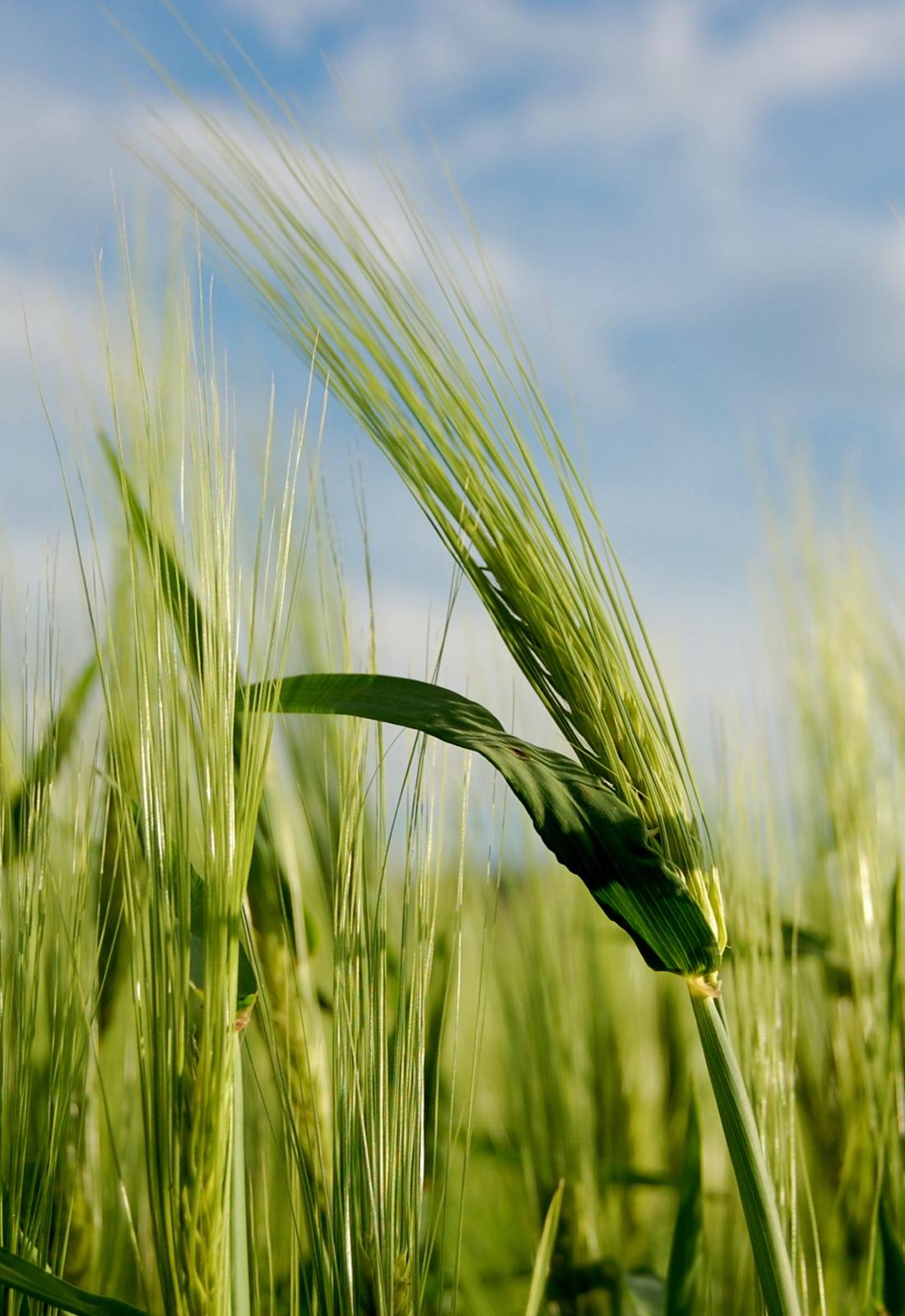
What is the difference between 2-row and 6-row barley?
In 2-row barley, only the central floret at each node is fertile, producing two orderly rows of kernels. In 6-row barley, all three florets are fertile, producing six rows. Two-row grain often has larger, more uniform kernels and is widely used for all-malt brewing. Six-row grain often has more husk, higher protein and stronger enzyme potential, traits historically useful in adjunct brewing. These are tendencies—not purchase specifications—so the actual variety and malt analysis must decide suitability.
The botanical difference is fertility at each node
A barley spike carries groups of three florets at each node of the rachis. In a two-row type, only the central floret normally develops a kernel. In a six-row type, the central and two lateral florets are fertile. The University of Minnesota describes the result simply: one kernel forms at each node in two-row barley and three kernels form at each node in six-row barley.
The Canadian Grain Commission recognizes both two-row and six-row classes and also distinguishes covered from hulless barley. Row number therefore describes spike architecture; it does not by itself establish that a lot is malting grade.
2-row vs 6-row barley comparison
| Characteristic | 2-row barley | 6-row barley |
|---|---|---|
| Fertile florets per node | One central floret | Three florets |
| Rows of kernels | Two | Six |
| Kernel shape | Often larger and more uniform | Lateral kernels can be smaller and less symmetrical |
| Husk contribution | Often lower | Often higher, which can support wort filtration |
| Protein tendency | Often lower in comparable malting samples | Often higher, depending on variety and crop |
| Enzyme tendency | Usually moderate to high | Historically selected for high diastatic power |
| Common brewing fit | All-malt lager, ale and craft brewing | Adjunct mashes that need additional conversion capacity |
| Decision rule | Use the approved variety, crop-year analysis and buyer specification—not row number alone. | |
Kernel uniformity affects malting consistency
Uniform kernels hydrate and germinate at a more similar rate. This helps the maltster control steeping, modification and kilning across the batch. Six-row heads can contain plump central kernels alongside thinner lateral kernels, so sizing and grading become especially important. A well-selected six-row lot can still be highly suitable; the point is to measure uniformity rather than infer it from the label.
Protein and enzymes must be read together
Protein supports enzyme development and yeast nutrition, but excessive protein can reduce extract and create processing problems. Diastatic power indicates the malt's ability to convert starch. Six-row malt has traditionally been associated with stronger diastatic power, while two-row malt is often chosen for high extract and a cleaner all-malt base. Modern breeding has narrowed many historical differences, making the certificate of analysis more useful than a stereotype.
Which type is better for brewing?
Neither type is universally better. The appropriate choice depends on the recipe, the percentage of unmalted adjunct, the brewhouse and the target beer.
Practical selection guide
- All-malt beer: a uniform two-row base malt is commonly selected for extract yield and predictable processing.
- High-adjunct lager: confirm that the malt provides enough diastatic power to convert the added corn, rice or other starch.
- Filtration-sensitive process: husk contribution and kernel integrity can matter, but they should be checked in the actual grist and lauter system.
- Regional procurement: choose an accepted variety that is available, agronomically adapted and supported by the maltster or brewer.
Craft brewers have often preferred two-row varieties, while six-row barley has a long association with North American adjunct brewing. Current practice is more flexible: maltsters can blend, breeders can select different quality profiles and brewers can adapt recipes. The safest language is therefore “typical tendency,” followed by analytical confirmation.
What buyers should verify before contracting
Row number is only the first line of a malt or barley description. A commercial decision should also cover:
- approved variety and varietal purity;
- germination energy and capacity;
- kernel plumpness, sizing and uniformity;
- moisture, protein and extract potential;
- diastatic power and alpha-amylase for the intended mash;
- beta-glucan, friability and modification in finished malt;
- disease, mycotoxin, storage and food-safety requirements.
For the analytical definitions behind those checks, use the malting barley quality standards guide. To see how the raw grain is transformed, continue with the malting process steps.
Common questions
Is 2-row barley always lower in protein?
No. It is a common tendency in comparable malting material, but variety, nitrogen management, weather, yield and region strongly affect protein. The lot analysis is authoritative.
Does 6-row barley always have more enzymes?
No. Six-row malts have historically been selected for high enzyme strength, but modern two-row varieties can also deliver substantial diastatic power. Compare the malt specification.
Can both types qualify as malting barley?
Yes. The Canadian Grain Commission, for example, recognizes malting classes for both two-row and six-row varieties. Acceptance still depends on the designated variety and grade requirements.
Can you identify the type from loose grain alone?
Kernel shape can provide clues, but definitive classification is safer from varietal records, the intact head or validated identification methods.